

Next week marks the 30th anniversary of the collapse of Barings Bank, the historic City institution brought down by so-called “rogue trader” Nick Leeson.
Leeson concealed mounting losses in a hidden account, which eventually reached £827 million as he pursued increasingly risky trades in an attempt to recover. His strategy unravelled in early 1995 when a major earthquake triggered a market downturn, sealing the bank’s fate.
Three decades later, Leeson warns that the current push for deregulation could pose renewed threats to financial stability.
In his autobiography Rogue Trader, Nick Leeson described Barings’ ethos as straightforward: “We were all driven to make profits, profits, and more profits … I was the rising star.”
Leeson did generate enormous sums for the bank, earning £10 million in 1993—accounting for 10% of Barings’ total profits that year. However, in 1995, the revelation of a hidden account—Error Account 88888—exposed the staggering truth: Leeson had gambled away £827 million under Barings’ name.
The City’s oldest merchant bank was doomed.
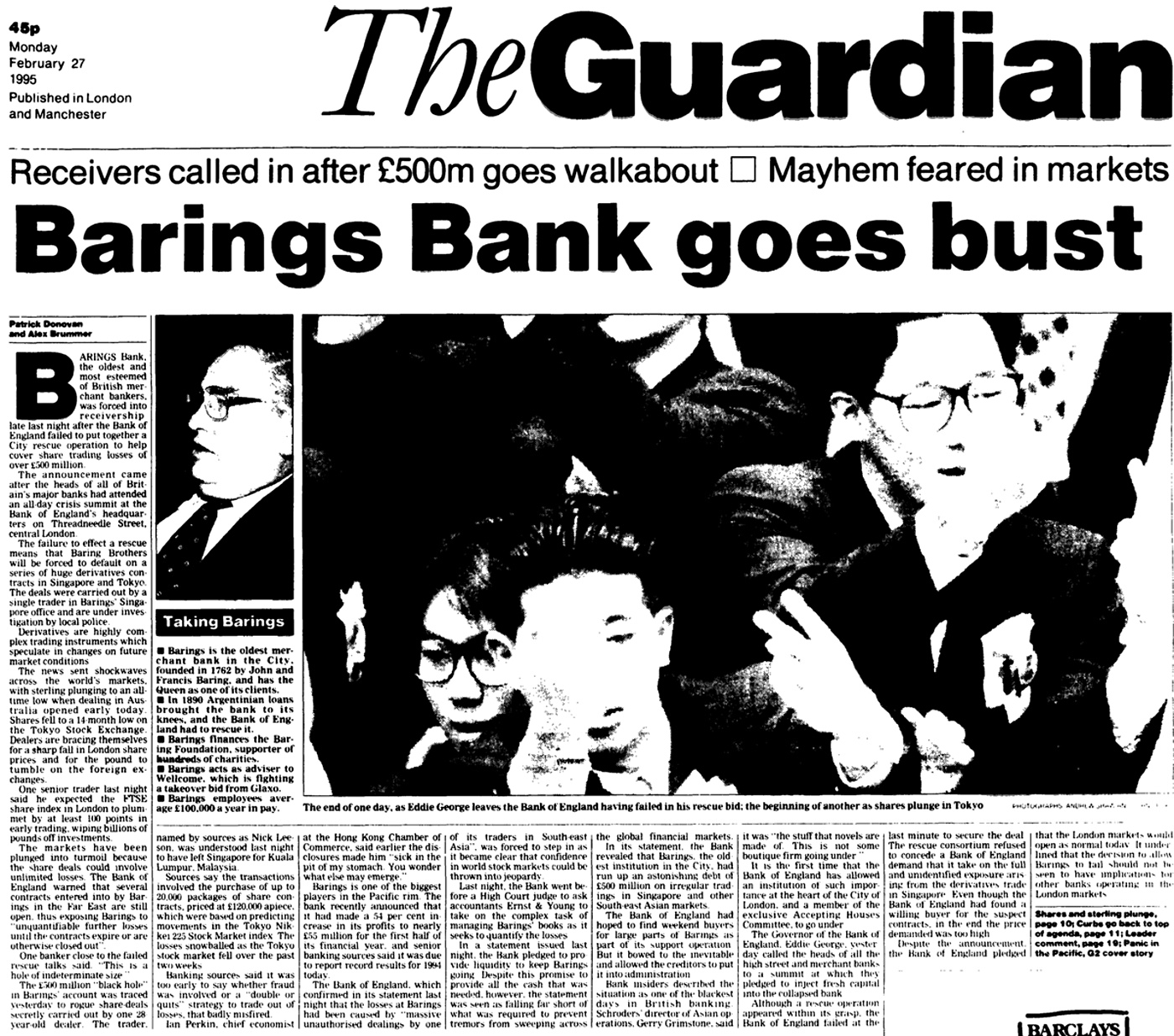
As stock markets reeled from the biggest financial scandal in years, Watford-born Nick Leeson fled Barings’ Singapore office, leaving behind a simple note: “I’m sorry.” He then went on the run.
In his absence, a complex portrait emerged of the 28-year-old trader whose success in the currency markets had earned him a £200,000 annual salary. Some colleagues hailed him as “brilliant” and “the most confident trader in town.” Others saw him as a “high-flyer drawn to reckless, high-stakes trades.”
As a global manhunt intensified, Leeson shocked everyone by resurfacing at Frankfurt Airport several days later. He then fought a nine-month legal battle to avoid extradition to Singapore—a fight he ultimately lost.
Nearly a year after his dramatic escape, Leeson arrived at Singapore’s Changi Airport under tight security. Dressed in gym gear with a backwards baseball cap, he appeared unfazed. He was swiftly charged with forgery and fraud for his role in Barings’ collapse.
At his trial in Singapore District Court, Leeson—who had been held in Tanah Merah maximum security prison—pleaded guilty to charges of forgery and fraud. His lawyer, seemingly in an appeal for leniency, told the court that Leeson’s wife had suffered a miscarriage and that he was financially ruined.
The judge remained unswayed and handed down a sentence of six and a half years in prison.

The risk of a longer prison sentence deterred Leeson from appealing, and he ultimately served four years in a Singapore jail. During his time behind bars, he was diagnosed with colon cancer and underwent treatment.
In 1999, Leeson was released and flew back to London, enjoying champagne and smoked salmon alongside British journalists on the flight.
His extraordinary story captivated the public, with the Sunday Mirror reporting that he had earned £200,000 from a book deal and a newspaper serialisation. He also received a share of the £7 million profits from Rogue Trader, the film adaptation of his story starring Ewan McGregor and Anna Friel.
As for Barings, it was acquired by Dutch bank ING in 1995—for just £1. Many of Leeson’s former colleagues lost their jobs in the aftermath.
Investors also suffered heavy losses, with their frustration deepening upon learning that the bank’s directors would still receive substantial bonuses.
A few months later, Chancellor Kenneth Clarke, who had already promised a “thorough” review of the banking regulatory system, presented a highly anticipated Bank of England report to the Commons. As expected, the report concluded that Barings’ downfall stemmed from “unauthorised and concealed trading positions” as well as “serious failures in management and internal controls within the Barings group.”
